· Trip I · America / Africa
Looking Back on South America
A man hops back and forth across the equator, weeps in front of whales, and discovers at the airport that he nearly forgot three whole months. Phil says goodbye to South America.

Translated from Deutsch. Read the original
"South America, what is that?" I asked myself in the departure hall in Buenos Aires, waiting for the jumbo that would carry us to Africa. The answer came promptly: "Buenos Aires, great city. Hectic, cramped, clogged, yet full of charm and surprisingly green thanks to all the trees and balcony plants. As in Italy, everything somehow runs more smoothly than it looks, as if by magic. Montevideo: the sound of the name alone justifies a visit to the Uruguayan counterpart of the Argentine capital. Iguaçu, the luxury bus back, not even three dollars dearer than the rattletrap on the way there. Before that, Patagonia and its birds. Yes, the birds got me. So varied, so numerous, cheeky and sleepwalker-sure in the hearty wind that could rage as furiously as it liked at their insulting lightness. And the whales. You should have seen the whales. A power that only nature can show. That was South America." And then I startled myself. No, that is not South America! That is not even my South America. That was the last few days. Three months on the road, and my memory serves up the brochure of the final week. So much for the attentive traveller. "South America, that is …"
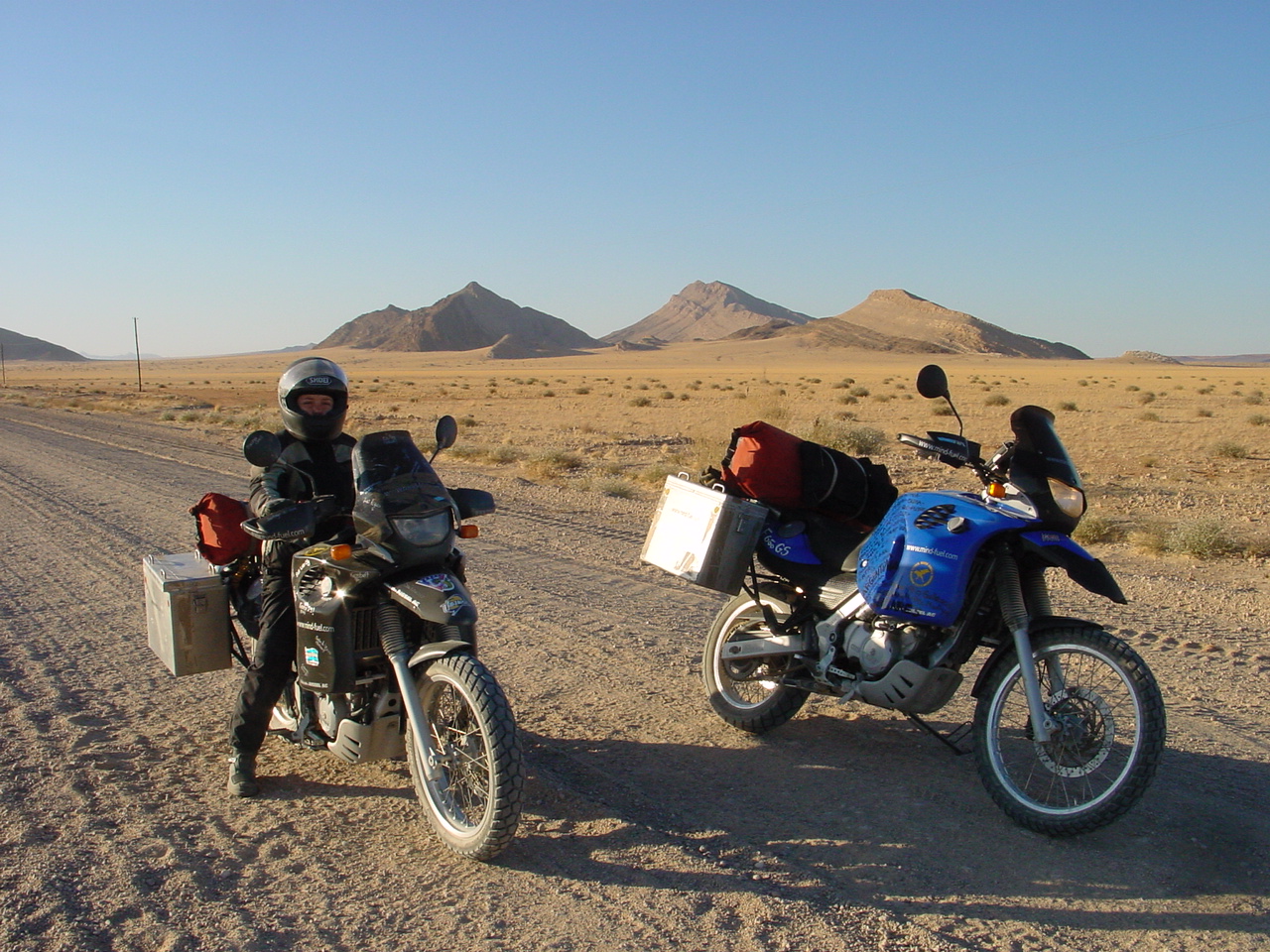
Jasmin and I have now been in Africa for almost two weeks, and today we reached Swakopmund in Namibia. Africa is different: the landscape beyond compare, dozens of new animals again. The people, their culture, their language – I don't understand a word. And how I look forward to learning more. To do that I urgently need to clear some space in my head, and only now do I notice how firmly Latin America still has hold of me. We didn't travel South America, we lived it. On a motorcycle, unlike on a package tour, you are forced to approach your surroundings, if only to ask the way in a village of a hundred souls. We handle everyday life in fluent Spanish, and understanding comes almost without effort. We know where to find what, or at least whom to ask. In Argentina it felt like home. And it was: Latin America had become our everyday life. A man rides halfway round the world to escape his daily routine, and the first thing he acquires on the way is a new one.
It began in Quito, Ecuador. With a slight cold, I struggled with the 2,800 metres above sea level: dry throat, wheezing lungs, a mild headache. There was no pity, only the merciless programme of Carlito, a friend of that devil of a man Edison, who had brought our bikes into the country without a Carnet de Passage (customs document): two hours of Quito by night. Then the equator. Crossed on foot! One step forward, northern hemisphere. One step back, southern hemisphere. Forward, back, hop, forward, back – I could do this for hours. A grown man hopping back and forth over an imaginary line. Just imagine: the middle of the Earth. One step and you switch sides. I stretch out my arms and lean forward. I have never hurtled through space as fast as I do here, if you imagine the atmosphere away. You can even work it out: the full circumference of the Earth in 24 hours. You may as well lean a little to the east. What I would rather not imagine is that with every kilometre south – north is up, says the school atlas – I hang a little more upside down, and at this hellish speed, too. Otherwise I feel queasy and dizzy, even at sea level. Seasick from my own view of the world. Quite an achievement.
At some point we move on, through the colourful Andes of Ecuador; nowhere else do they glow so brightly. At the markets the fruit is stacked into towers, two, sometimes three high, preferably taller than at the neighbouring stall. Ambition knows no altitude. On a Sunday morning the people glow too, in rich colours, in lavishly patterned woven cloth. They stream to the churches in droves, on foot or on the backs of lorries. Where we ride past, they pause for a moment, and we wave at each other. I never want to forget that morning. Nor the Sunday in Putre, Chile. Back at medium altitude, we rest for a day to get used to the thin air. From the village chapel a stomping, driving melody booms, over and over again. Inside, wind players and drummers to left and right, the people dancing as if in a trance, the priest at the front. Everyone knows the sequence of the ritual. Everyone except us. After quite a while, but before the end, we trudge on. Between the two Sundays lie a few thousand kilometres of Peru: coastal roads, thick, clinging fog. After Putre came La Paz, Bolivia. This country forces you to live, to survive. In hindsight I find it beautiful for precisely that reason, because we had to fight for it. It takes effort, you have to dare something and afterwards you are the hero. Wild West romance, it scratches at the instincts. Memory is a merciful bookkeeper: whatever cost the most, she enters as profit.
At last it got warmer. After cold, barren deserts and frosty Andean nights, we rewarded every degree with a laugh. Shortly before Santiago de Chile came the first breakdown: total failure of my vehicle. Thrilling as a crime novel, we made it to the capital. There we met the firecrackers at BMW, who can't tell a BLUE motorcycle from a black one and replaced the cooling system on a perfectly good machine. Then south, back into the cold, as if we wanted to outrun the spring and catch up with winter once more. Climate zone by climate zone it got rougher and windier, all the way to the snowy, jagged mountains at the very bottom of the continent. And in the midst of the bleakness, this wealth of animals: ostrich-like birds, pink flamingos, chirpers the size of the ball of your hand, walruses, penguins in the man-high waves of the Strait of Magellan, not to mention the woolly jumpers that stand around everywhere, now as sheep, now as llamas. The crowning highlight: the whales in the bay off Puerto Madryn. I was riding standing up on a gravel track along the cliffs, and level with me on my left a pod of whales moved on, calm and steady, in the same direction. I cried. Partly because it was once again brought home to me how far I usually am from this life energy in my working everyday life. And partly because the scene mirrored life itself: transience, the knowledge that this moment will never come again and will remain only a sweet, tender memory. Being able to let go. Feeling not longing but awe and gratitude for the breath of life that nature gave us there. That's the theory. In practice, a man sits in the departure hall and looks back.
South America, I'll be back.
km on the road · Day 211