· Trip IV · India / Asia / Australia
My driver is an idiot
Why India will always come second, what cough syrup has to do with it, and how a haggling tiger in Kerala ends up out of work.
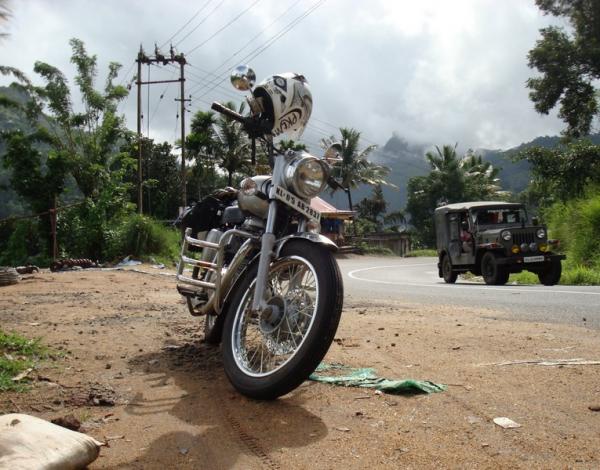
Translated from Deutsch. Read the original
Even setting aside the overwhelming two weeks with the wedding family, India floods us with impressions, and Jazz and I soak them up like sponges. In the evenings I tend to collapse – oh, who am I kidding: by early afternoon I'm usually dog-tired and would happily lie down in the middle of the road next to the peacefully ruminating cows. Ruminating on experiences. The cows seem to have a lot more practice at it than I do.
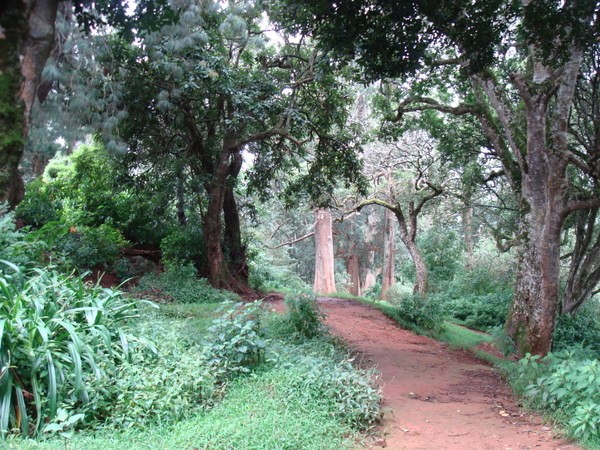
We process our days by talking. We tell each other what we saw, what we feel and what we think. In the process, the past inevitably seeps into how we judge what we've experienced. Learning from experience is, after all, the whole point of being alive. So Jazz and I keep comparing things with earlier trips: the forest looks just like that one, people here live much as they did over there, and so on. Seen that way, it's rather unfair to India that in so much of what we meet every day it will always come second. I will never know how India would have struck me without all that travelling beforehand. Just as you will never know whether your cough got better faster, just as fast or even slower thanks to the cough syrup. Because that one particular cough is one you will never have again. You're already older now than you were at your last cough. You'll take the syrup if you believe it helped, and skip it if you think a good long sleep works just as well. What's true is always what you want to believe. People who travel a lot collect not just countries but comparisons – and those come along uninvited.
Which leaves the question: how do I actually want to see India? Now and then I've stumbled across travel reports online so steeped in negative thoughts that I felt I was reading the news in a newspaper. Admittedly, travelling can be exhausting at times (is it age?). When, after a day in black clouds of exhaust, my eyes sting and my bronchial tubes scratch, when the scorching heat stinks of urine and dead animals, when the loudest housemates are the two staff members in the lobby and it sounds as if they're shouting straight through the broken louvres into the bathroom with the broken shower – that's exactly when I think: "I've done this already. I don't want this. Why am I doing this?" The honest answer is probably: because I chose it myself.
I have never in my life experienced such violent monsoon rain! The water hammered down in unimaginable quantities and at unimaginable speed. Two big buckets catching the rain from a small tin roof were brim-full within seconds. No tap in Switzerland could have filled them faster! Jazz and I stand sheltered under the huge roof of a terrace, watching like children in amazement as hollows fill up, overflow and set off to join further streams, forming an ever-bigger brook. And at the exact moment when the roof roars so loudly that you'd think no waterfall in the world could hand any more cubic metres per second over to gravity – it gets even louder! That, I suppose, was the number one.
Or have I already told you about the traffic rules in Kerala? Flashing left or right means: we're not quite sure, best to wait and honk. Hazard lights in daytime mean: I'm going straight ahead. In fog: caution, fog. To turn, you stick your hand out of the window; there are also hand signals for "you can overtake me" and "whatever you do, don't overtake now". Headlights in daytime mean "let me through, it's an emergency". Driving is on the left, in principle, except that this doesn't apply to bus drivers: they may always use both lanes. Lorries prefer the middle, motorcycles are to keep to the edge. Honking: yes, always. As Jense explains to us: better to honk once too often than to brake. A honk can mean anything from the European "get lost" (rare) to "look out, here I come!" (the rule). At night, of course, you drive with lights on, and after about seven o'clock, once darkness has fallen, there's no more honking – at least not with the noisy thingamajig, only with the headlight flash. You drive on high beam; to flash, you switch to dipped beam. In general, honking also settles the question of right of way splendidly. Chaos? No. A system I just don't understand yet.
When a frame bolt goes missing on Jazz's Royal Enfield for the second time, we pull up at a Honda mechanic's. Strictly speaking, we go on foot first, the 20 metres from our favourite café, where our coffee comes unasked in a paper cup, a spoon comes with the delicious breakfast and the sauces arrive in little bowls. We explain our bolt problem to the doorman of the Honda dealership. He says they only repair Hondas. I say "I'll be back" and return shortly afterwards with the Royal Enfield (but without a weapon). Before I can act out the missing bolt in my slowly maturing mime routine, he invites us into the courtyard. There, some four mechanics are already waiting with friendly grins on their faces. At some point it was clear who would take care of it, a little later a suitable bolt had been found, and really it wasn't long before four cheerful people were waving us off. My mime talent went unused.
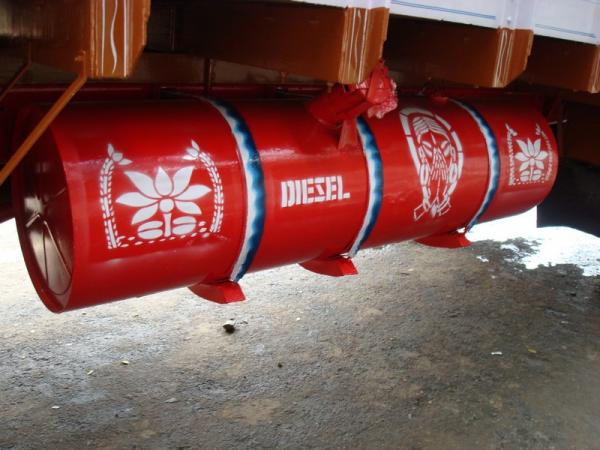
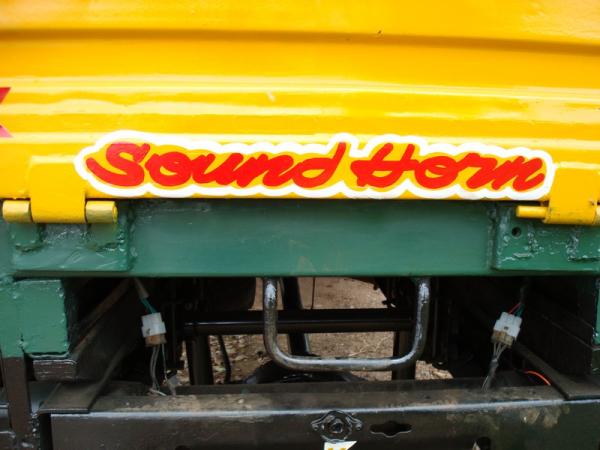
I especially like the colourful, hand-painted lorries. Most of these sometimes ancient carts are decorated with a positively loving eye for detail. The tank is swooshingly labelled "Diesel", and on the back it says "Sound Horn", the invitation to honk when you want to overtake. Every piece is signed, usually with the artist's name and phone number. Of course not everything by the roadside is so well kept. But neither heaps of broken glass nor plastic bags line the way. For one thing, there isn't much on sale in glass; for another, alcohol bottles seem to be collected in exemplary fashion. India is on a tremendous economic climb, and it's nice to see an effort not to repeat certain mistakes made by other countries. Instead of plastic bags, goods are wrapped in old newspaper – for anyone who doesn't own one of the jute bags available everywhere.
Long before setting off, I had mentally prepared myself for hard haggling. I would fight like a tiger for every rupee, just as I'd learned in the tough school of Central America. Anything above 50% of the opening price: a personal defeat. But how wrong I was. Anything that comes packaged in any way carries a "Maximum Retail Price", the MRP. Away from the tourist trails, shops naturally try to win customers with discounts. Just as naturally, in tourist areas they put the MRP straight on the table. And there he stands, the tiger, with nobody to fight.
And then there was this young man from Dubai. "My driver is an idiot!" he said, right after introducing himself. Oh, how we laughed afterwards! But I really can't tell you everything; there is so much every single day.
km on the road · Day 25