· Trip IV · India / Asia / Australia
Very Mystery
Nuclear power and used toothbrushes, prayers and burning plastic: Phil rides to the eastern end of his Indian journey and mostly finds new questions there. And a man who waves.
Translated from Deutsch. Read the original
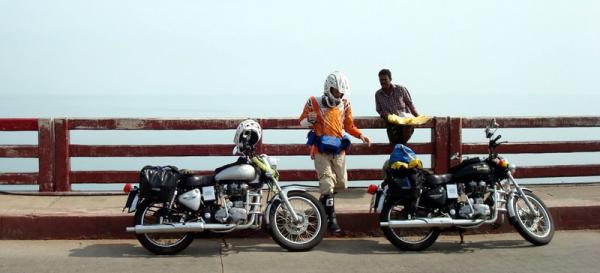
Change of scene. Jazz and I climb onto the unloaded Royal Enfields for the second time today. We want to ride to the easternmost point of the island, which is also the easternmost point of our trip through India. At walking pace we pass through the gate in the hotel compound's fence, greeting the two guards with a little wave. After a few metres of hard, rippled sand, past the pilgrims' minibuses, we carry on along the narrow paved road. Before the road widens and the bathing area for the faithful begins, we turn sharply right and squeeze down a small unpaved lane between tiny single-storey houses. The track, about 200 metres long, runs parallel to the road that leads from the bathing area to the temple's main gate. Along that main road walk the many men who have washed themselves ritually in the sea, and the women who will wait to wash until the sun has gone down. Barefoot, they stroll past dozens of stalls selling everything under the sun, from plastic cricket sets to fragrant incense sticks to shell-trimmed mirrors. It is colourful, the mood pensive for some, cheerful for others. You dodge the cows, who in their serene contentment lick scraps off the ground or lie there chewing the cud. At this hot hour of the day there are no dogs to be seen yet on the shadeless street. Still, the side lanes are easier going for us. Besides, we aren't even allowed to ride a motorcycle on the pilgrims' road. Earlier today, with the loaded bikes right behind the bus, I admittedly paid no attention to the faded prohibition sign. My eyes were glued to the bus. You could call it trust in God. I call it tunnel vision.
On the GPS display I can see that we've reached the right latitude. Now sharp left, and we stab back out onto the paved road, diving into the loud, restless bustle of early evening. We head roughly in the direction where we expect the edge of the village to be and weave between schoolchildren in uniform, auto rickshaws, buses, pilgrims and workers heading home. Nice and slow, nice and smooth, avoiding hard braking on the sand-covered roads. At this hour an imam calls out from somewhere far off. Driving, rhythmic sounds of soft percussion and strings melt into the high voice of a female singer, seep out of every crack of the little prayer houses and blend with similar waves from the loudspeakers of the main Hindu temple. The bus stops are crammed with people waiting, the tea stalls and sweet shops are running at full tilt. We find the right turn-off first try, and the great crush thins out a little. The two-storey buildings of the centre give way to single-storey ones, then come the first thatched huts. Between the houses there are now open spaces, strewn with rubbish. Little pigs and goats romp on the fresh heaps. The odd children standing on the rubbish aren't wearing school uniforms. A sentence that is easy to write and hard to forget. Older, "grazed-over" piles are being set alight, the dark smoke of burning plastic mixing with the exhaust fumes of the now full buses that overtake us smartly to get their passengers home as fast as possible. The smell is sometimes dull, musty and mouldy with rot, sometimes sharply sour, or so piercing and acrid that it takes my breath away. Immediately I focus on my pulse, suppress my breathing, try to control every bodily function and cut my energy consumption so as to put off the next breath for as long as possible. A yogi would be proud of me. Only the yogi is seeking enlightenment, and I just don't want to smell anything. So my spirituality isn't all that impressive after all.
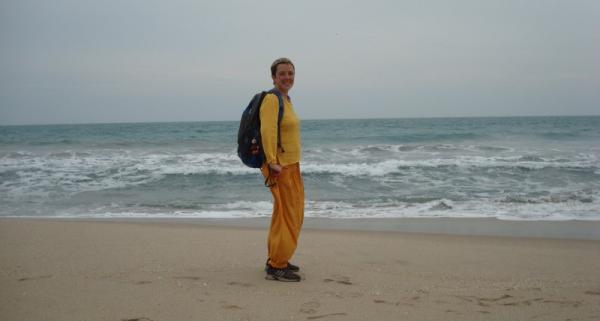
Towards the end of the settlement the houses thin out even more. Finally the rubbish dumps fray away, and the air smells increasingly neutral. The paved road is in good condition, and we make comfortable progress. Whenever there's a gap in the scrub, we see the nearby sea to the left and right. Now it's almost deserted. A few women are rounding up their small herds of goats, making sure the animals don't keep foraging on the other side of the road. The sun will set in an hour, and there are no power poles on this narrow strip of island. Hazy clouds hide the sun and gradually drain the landscape of colour. After half an hour's ride the first buildings appear since we left the village: a small cluster of thatched huts, with a little obelisk of dark brown stone in the middle. The diffuse, glaring light turns the sand, the washed-out thatch of the huts and the roaring sea into shades of grey. Unreal, extraterrestrial. As soon as I take off my helmet, a strong wind tousles my by now long hair. Locals come running up, none of them speaking English. We trudge through the fine sand and walk the ten metres to the moving edge, where wave after wave defines a new order. Here the island ends, and with it our journey eastward through India. From here on it only continues in the mind. In a group of Indian tourists, one man waves at me. With his arm stretched out he beckons me over, repeatedly flicking his fingers against the heel of his hand. I stare at him. He tosses me a "Camera", and the gesture becomes a little more dynamic. I stopped responding to such gestures long ago. The experience of travelling. Or stubbornness, depending on whom you ask. He has just as far to walk to me as I do to him, I think. And I want neither to be photographed by him nor to take a photo of him. Whoever has money buys a big car. Whoever has a big car has right of way over the smaller ones. Being on top means power. Legacy of the caste mindset. Whoever lets himself be waved around is below. I stay put. So does he. Two grown men at the end of an island, and neither moves a metre towards the other. Matter settled. Nobody won, to be honest. Not even the photo.
We had already reached the village that morning. In the centre stands the big temple with its two tall towers, covered in colourful, symbolic figures from their religion. On the four streets around the temple, shop follows shop: hotels, souvenir stalls, sellers of ready-packed offerings and of garish powder with which people, after prayer, daub a mark on their forehead with one finger. We had expected a lot from this place, because in Madurai a kind fabric seller had told us, eyes shining, about the beauty of the holy site. The houses stand packed tightly together, every centimetre seemingly used to meet the needs of the crowds of visitors. I was glad when we found the hotel a little way from the centre, since it must surely be quieter there than right beside the place of prayer. While we wait for our room, a group of elderly men dressed in white speaks to us. At least two of them speak very good English. A little conversation gets going, naturally: where from, where to. One wants to know whether we have a road map. The same man explains to us later that they are the ten district councillors of one of six districts, holding a meeting here. Together they rhapsodise about a scholar whose complicated Indian name I couldn't possibly remember. A gentleman he was, very learned, a scientist and researcher. He had no wife and lived by the highest moral standards in every other respect too. When I ask what has remained of this spirit and legacy in India today, the group falls silent for the blink of an eye. The most eloquent of them reacts fastest, flings his arms wide towards the sky, laughs and says: "That, only God knows." Elegant. I had asked a question; he forwarded it.
Later in the day I learn (once again) that there are hardly any points of contact between Indian culture and our Western one. Religion and faith shape daily life and the view of life itself. As I perceive it, people here don't do anything merely for entertainment. On this stretch of sea, anyone who wishes can cleanse themselves ritually in the water, at a staircase 25 metres wide that leads into the sea. Beside it there is nothing, but really nothing, that would otherwise invite you to linger, let alone swim. The beach with its fine, pale sand is strewn with rubbish. Barely twenty metres from the stairs, the metallic, mirror-like water of the little sewage channels flows into the sea in an insistent, leaden blue-grey. Where in other parts of the world beach hut would follow beach hut and deck chairs and towels would have to serve in territorial battles, here, on this gorgeous beach garnished with coconut palms, there simply isn't a single stretch where anyone would voluntarily dip even a foot in the sea. The sea here serves the soul, not the beach towel. And my Western soul, I confess, would like both.
In many ways India remains a mystery to me. At the start of our stay I experienced the overwhelming hospitality inside an Indian family. On the street I experience the animal ruthlessness outside the family circle. I see a nuclear power with every technical possibility modern life has to offer. I see street vendors selling used toothbrushes. I see uncritical pride in an education system that, on the surface, knows only winners. I see an education not anchored in the Enlightenment, in which there is no equality, neither between high and low nor between the sexes. I see films in which every even remotely erotic scene is generously cut out. I see the usual unimaginative advertising for cars, jewellery, hair shampoo, skin cream, insurance and fast food. I see newspaper articles campaigning for more justice and environmental protection. India, where are you going? That, only God knows. I certainly don't. And yet, thanks to GPS, I know to the metre exactly where I'm standing. I just don't know what I'm seeing.
PS: Even in 2010, even in India, only the pale skin type exists in advertising. Why? Can somebody please explain that to me?
km on the road · Day 45