As a law of nature the dominant culture wipes out the inferior opponent rigorously not leaving any traces but a prosperous self. If at all, the defeated exist as a tolerated rather than accepted minority.
Are we humans any better than let’s say viruses?
Aborigines are highly disturbing my Australia experience. Not in terms of molesting me, more like occupying my thoughts and feelings about the world we live in and the western system I see myself as part of it. The (white) people I talk to are roughly split up in two polarized groups: Aborigines are all good, far advanced of our understanding of living in a spiritual sense and in perfect, sustainable unity with mother earth. The other ones believe that Aborigines are a bunch of retarded blokes, hanging around, getting government money for doing nothing. Neither of it is true in my personal opinion. There’s no reason to glorify a “sustainability” if it’s the only way ever possible to survive. I see a difference whether living sustainable is chosen to reach a higher goal or if it’s just given from nature itself. And to verify if Aborigines are not more than lazy people, just take a look at a map to see where the economically promising regions of Australia are and where the allotted Aboriginal territories. You won’t find a single interleave making me think about if the traditional inhabitants of this continent are tolerated or accepted.
The scars of history are relatively fresh, a lot of prejudicing on both sides present. Barry and Mike are two social workers, walking on a ridge of showing empathy, pity and giving positive impulses to move forward. With the permission of Mike, let me share his personal story:
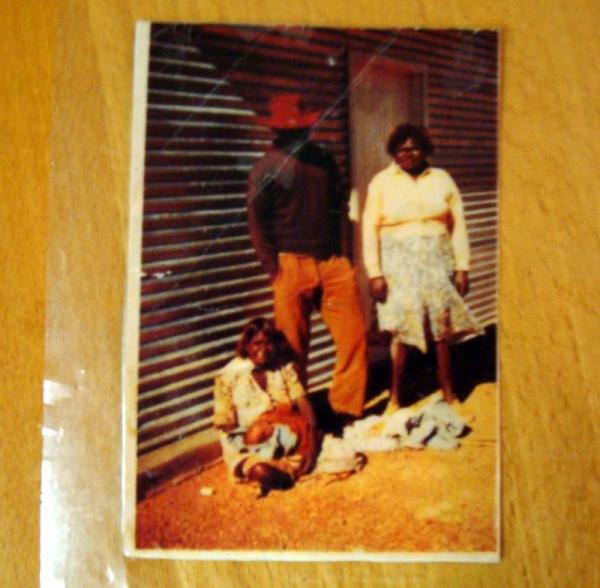
When he showed me a laminated, aged photography with three adults on it, his voice went silent. “That’s me”, nearly inaudible, he pointed on the sitting woman with a fresh born baby in her arms. Staring on the picture, he remained silent for quite a while. A powerful moment fills the room to which Barry and he had invited me to have a nice homemade stew for dinner. This picture is all he has of his family. And I mean all. Short after it was taken, he came to a missionary institution for the next twelve years. After this twelve years the inexplicable. According to some state law he was dropped in a street of a nearby city he never was before. In front of a supermarket with a pillow and a sheet. No money, no food, no nothing. In this precise moment he knew: “You have to look for yourself in life”.
There’s a lack positive examples in the Aboriginal communities. Many of them are stuck in despair; young people can’t see another way than the way their parents live. Mike tries to be an example of taking responsibility. He enforces courage to step out of the shadow of prejudice. His personal story is a shining sign of hope in a cloudy sky. Not only for Aborigines but for all of us.
---
Written on the 237th day of trip IV - India/Asia/Australia
19'170 Km on the road